You are mid recipe, hands dusted with flour, and you suddenly realise the instructions call for “½ cup” but all you have in front of you is a set of tablespoons. Or you’re following a recipe written in London, everything in grams and your kitchen runs entirely on American cups.
Neither problem is complicated. Both problems are, at that precise moment, actions. Cooking is flexible. Baking is not. That is why kitchen measurements matter so much. This guide gives you the most useful kitchen conversions in one place, including cups to tablespoons, tablespoons to teaspoons, cups to ounces, cups to grams, butter charts, flour charts, and sugar charts.
How kitchen conversions work
Kitchen conversions depend on two things:
1. Volume
Volume measures how much space something takes up.
Example:
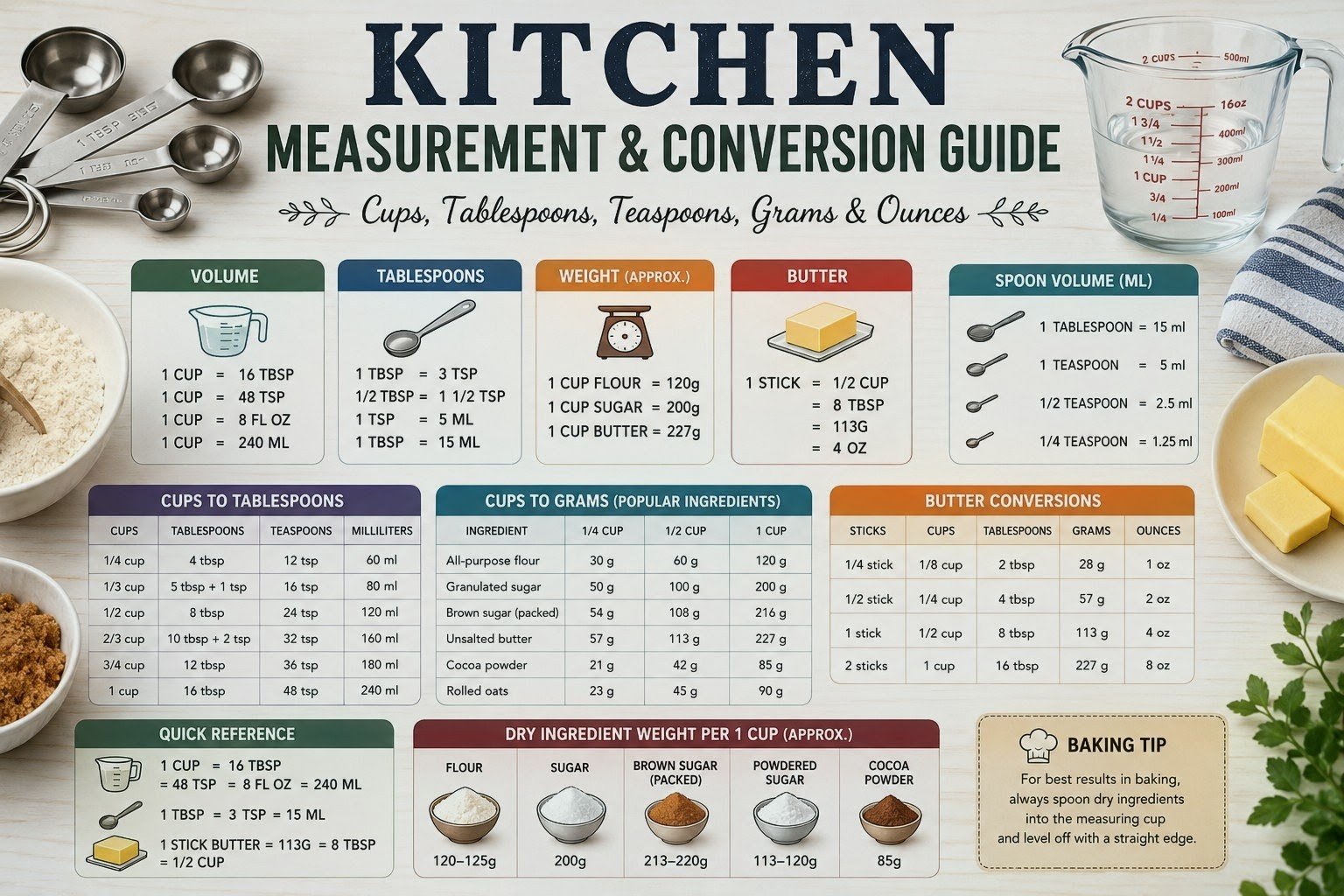
- 1 US cup = 16 tablespoons
- 1 US cup = 48 teaspoons
- 1 US cup = 8 fluid ounces
- 1 US cup = 240 ml
These volume conversions are fixed.
2. Weight
Weight measures how heavy an ingredient is.
That is why 1 cup of flour does not weigh the same as 1 cup of sugar. Different ingredients have different densities.
Examples:
- 1 cup flour ≈ 120g
- 1 cup sugar ≈ 200g
- 1 cup butter ≈ 227g
Cups to Tablespoons
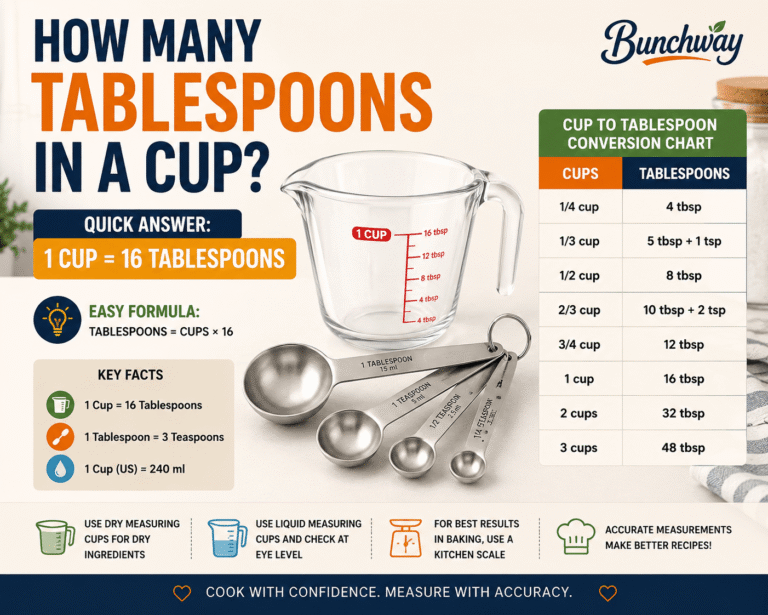
If you were to pick one kitchen conversion to memorise above all others, make it this: one cup equals sixteen tablespoons. That single fact unlocks every fraction in between. It means a half cup is eight tablespoons, a quarter cup is four, and that awkward third cup is five tablespoons plus one teaspoon.
| Cups | Tablespoons | Teaspoons | Millilitres |
| 1/16 cup | 1 tbsp | 3 tsp | 15 ml |
| 1/8 cup | 2 tbsp | 6 tsp | 30 ml |
| 1/4 cup | 4 tbsp | 12 tsp | 60 ml |
| 1/3 cup | 5 tbsp + 1 tsp | 16 tsp | 80 ml |
| 1/2 cup | 8 tbsp | 24 tsp | 120 ml |
| 2/3 cup | 10 tbsp + 2 tsp | 32 tsp | 160 ml |
| 3/4 cup | 12 tbsp | 36 tsp | 180 ml |
| 1 cup | 16 tbsp | 48 tsp | 240 ml |
| 2 cups | 32 tbsp | 96 tsp | 480 ml |
| 4 cups (1 qt) | 64 tbsp | 192 tsp | 960 ml |
Cups to Fluid Ounces
| Cups | Tablespoons | Teaspoons | Fluid Ounces | Milliliters |
| 1/4 cup | 4 Tbsp | 12 tsp | 2 fl oz | 60 ml |
| 1/3 cup | 5 Tbsp + 1 tsp | 16 tsp | 2.67 fl oz | 80 ml |
| 1/2 cup | 8 Tbsp | 24 tsp | 4 fl oz | 120 ml |
| 3/4 cup | 12 Tbsp | 36 tsp | 6 fl oz | 180 ml |
| 1 cup | 16 Tbsp | 48 tsp | 8 fl oz | 240 ml |
Practical Scaling Cheat Sheet
- Do you want Doubling a recipe? Then, multiply every tablespoon count by 2.
- Halving? Divide tablespoon count by 2. For odd tablespoon amounts, convert the remainder to teaspoons.
- If ¾ cup missing from your set. Fill ½ cup once, then add 4 tablespoons.
- Do you Need ⅔ cup? That’s 10 tablespoons plus 2 teaspoons fill your 1 tbsp ten times, then add 2 tsp.
Tablespoons to Teaspoons
A beginner or pro 1 question has a common question: “How many teaspoons are in 1 tablespoon?”
One tablespoon equals exactly three teaspoons. It applies to vanilla extract, baking powder, ground spices, and every other small quantity ingredient in a recipe. If you memorise nothing else about teaspoons, let it be this ratio.
“baking powder and bicarbonate of soda — must be measured precisely. Even half a teaspoon too much baking powder produces a bitter aftertaste. Too little and your cake will not rise. Level off the spoon with a straight edge every time.”
Tablespoons → Teaspoons → Millilitres
| Tablespoons | Teaspoons | Millilitres |
| 1/4 tbsp | 3/4 tsp | 1.25 ml |
| 1/2 tbsp | 1½ tsp | 2.5 ml |
| 1 tbsp | 3 tsp | 15 ml |
| 2 tbsp | 6 tsp | 30 ml |
| 3 tbsp | 9 tsp | 45 ml |
| 4 tbsp (¼ cup) | 12 tsp | 60 ml |
| 8 tbsp (½ cup) | 24 tsp | 120 ml |
| 12 tbsp (¾ cup) | 36 tsp | 180 ml |
| 16 tbsp (1 cup) | 48 tsp | 240 ml |
Spoon Volume Comparison (ml)
- 1 Tablespoon = 15 ml
- 1 Teaspoon – 5 ml
- ½ Teaspoon = 2.5 ml
- ¼ Teaspoon = 1.25 ml
When Teaspoons Matter Most
- Baking powder: typically 1–2 tsp per cup of flour.
- Fine salt: most recipes call for ½–1 tsp; kosher salt is less dense — increase by 25%.
- Vanilla extract: 1 tsp = 5 ml; 1 tbsp = 15 ml. Scale accordingly.
- Ground spices: packed vs. loosely filled makes a real difference between spoon and level.
Cups to Ouncesmany home cooks stumble
The conversion between cups and ounces is not fixed. It depends entirely on whether you are measuring liquid or dry ingredients, and for dry ingredients, it depends on which ingredient you are weighing.
- For liquids: one cup equals eight fluid ounces, always.
- For dry ingredients: the weight in ounces varies by density.
- A cup of flour weighs roughly 4.5 oz.
- A cup of granulated sugar weighs about 7 oz. The cup holds the same volume of space; what changes is the mass of what fills it.
Liquid: Cups to Fluid Ounces
| Cups | Fluid Ounces | Millilitres | Pints / Quarts |
| 1/8 cup | 1 fl oz | 30 ml | — |
| 1/4 cup | 2 fl oz | 60 ml | — |
| 1/3 cup | 2⅔ fl oz | 80 ml | — |
| 1/2 cup | 4 fl oz | 120 ml | — |
| 3/4 cup | 6 fl oz | 180 ml | — |
| 1 cup | 8 fl oz | 240 ml | ½ pint |
| 2 cups | 16 fl oz | 480 ml | 1 pint |
| 4 cups | 32 fl oz | 960 ml | 1 quart |
| 16 cups | 128 fl oz | 3,785 ml | 1 gallon |
Dry Ingredients: Approximate Weight per Cup
| Ingredient | Ounces per Cup | Grams per Cup | Notes |
| All-purpose flour | 4.2–4.5 oz | 120–128 g | Spoon & level method |
| Bread flour | 4.8 oz | 136 g | Slightly denser |
| Cake flour | 3.9 oz | 110 g | Very light |
| Granulated sugar | 7.05 oz | 200 g | Consistent |
| Brown sugar (packed) | 7.5 oz | 213 g | Firmly packed |
| Powdered sugar | 4.2 oz | 120 g | Sifted — very airy |
| Cocoa powder | 3 oz | 85 g | Spoon, don’t scoop |
| Rolled oats | 3.2 oz | 90 g | Loosely filled |
Always check whether a recipe means fluid ounces (volume) or weight ounces (mass). “8 oz of cream” almost always means fluid ounces. “8 oz of cream cheese” almost always means weight. When in doubt, weigh it.
Cups to Grams
Converting cups to grams is the most important skill for anyone following recipes across borders. British, Australian, and most European recipes measure by weight.
The most important truth in all of baking: grams are always more accurate than cups.
Cups → Grams: Common Baking Ingredients
| Ingredient | ¼ Cup | ⅓ Cup | ½ Cup | 1 Cup |
|---|---|---|---|---|
| All-purpose flour | 30 g | 40 g | 60 g | 120 g |
| Bread flour | 34 g | 45 g | 68 g | 136 g |
| Cake flour | 27 g | 37 g | 55 g | 110 g |
| Granulated sugar | 50 g | 67 g | 100 g | 200 g |
| Brown sugar (packed) | 54 g | 72 g | 108 g | 216 g |
| Powdered / icing sugar | 30 g | 40 g | 60 g | 120 g |
| Unsalted butter | 57 g | 76 g | 113 g | 227 g |
| Cocoa powder | 21 g | 28 g | 42 g | 85 g |
| Honey | 85 g | 113 g | 170 g | 340 g |
| Rolled oats | 23 g | 30 g | 45 g | 90 g |
| Almond flour | 24 g | 32 g | 48 g | 96 g |
| Cornstarch | 30 g | 40 g | 60 g | 120 g |
Why the Same Cup Gives Different Weights
- Density is everything, honey is thick and heavy; icing sugar is a light, fine powder with plenty of air trapped inside.
- Scoop method vs. spoon method can add 20–30 g per cup of flour — that’s a meaningful difference in a cake.
- Brown sugar must be firmly packed; loosely measured brown sugar can be 40 g lighter than packed.
- Sifting flour or icing sugar before measuring decreases weight per cup by approximately 15–20%.
Butter Conversions
American recipes refer to sticks. British recipes call for grams or sometimes ounces. Older recipes say tablespoons. One American stick of butter equals half a cup, eight tablespoons, four ounces, or approximately 113 grams.From that single fact, every other butter measurement follows.
Butter: Sticks → Cups → Tablespoons → Grams → Ounces
| Sticks | Cups | Tablespoons | Grams | Ounces |
|---|---|---|---|---|
| ¼ stick | ⅛ cup | 2 tbsp | 28–29 g | 1 oz |
| ½ stick | ¼ cup | 4 tbsp | 57 g | 2 oz |
| 1 stick | ½ cup | 8 tbsp | 113–115 g | 4 oz |
| 1½ sticks | ¾ cup | 12 tbsp | 170 g | 6 oz |
| 2 sticks | 1 cup | 16 tbsp | 227–230 g | 8 oz |
| 3 sticks | 1½ cups | 24 tbsp | 340 g | 12 oz |
| 4 sticks | 2 cups | 32 tbsp | 454 g | 16 oz (1 lb) |
Butter: Tablespoons to Grams
| Amount | Grams | Ounces |
|---|---|---|
| 1 teaspoon | 4.7 g | 0.17 oz |
| 1 tablespoon | 14.2 g | 0.5 oz |
| 2 tablespoons | 28.4 g | 1 oz |
| 4 tablespoons | 56.7 g | 2 oz |
| 8 tablespoons | 113 g | 4 oz |
| 16 tablespoons | 227 g | 8 oz |
Flour Conversions
Flour is the most temperamental ingredient in the kitchen when it comes to measurement
All-Purpose Flour: Full Conversion Chart
| Amount | Grams (spoon & level) | Ounces |
|---|---|---|
| 1 tablespoon | 8 g | 0.28 oz |
| 2 tablespoons | 15 g | 0.53 oz |
| 1/8 cup | 15 g | 0.53 oz |
| 1/4 cup | 30 g | 1.06 oz |
| 1/3 cup | 40 g | 1.41 oz |
| 1/2 cup | 60 g | 2.12 oz |
| 2/3 cup | 80 g | 2.82 oz |
| 3/4 cup | 90 g | 3.17 oz |
| 1 cup | 120–125 g | 4.2–4.4 oz |
| 2 cups | 240–250 g | 8.5–8.8 oz |
Flour Type Comparison per One Cup
| Flour Type | Grams per Cup | Best Used For |
|---|---|---|
| All-purpose flour | 120–125 g | Bread, cakes, cookies, pastry, pancakes |
| Bread flour | 130–136 g | Yeast breads, pizza dough, bagels |
| Cake flour | 100–110 g | Sponge cakes, layer cakes, cupcakes |
| Whole wheat flour | 128–130 g | Hearty loaves, muffins, dense bakes |
| Self-raising flour | 120–125 g | Scones, quick breads; contains leavening agent |
| Almond flour | 96–100 g | Gluten-free baking, macarons, frangipane |
| Rice flour | 158–162 g | Gluten-free cakes, tempura batter |
| Cornstarch / cornflour | 120 g | Sauce thickening, shortbread, coatings |
Sugar Conversions
Sugar is more forgiving than flour when measured by volume. Knowing sugar weights will prevent you from over-sweetening a glaze or under-sweetening a cake.
Granulated White Sugar
| Amount | Grams | Ounces |
|---|---|---|
| 1 teaspoon | 4 g | 0.14 oz |
| 1 tablespoon | 12–13 g | 0.44 oz |
| 1/4 cup | 50 g | 1.76 oz |
| 1/3 cup | 67 g | 2.36 oz |
| 1/2 cup | 100 g | 3.53 oz |
| 2/3 cup | 133 g | 4.70 oz |
| 3/4 cup | 150 g | 5.29 oz |
| 1 cup | 200 g | 7.05 oz |
Brown Sugar (Firmly Packed)
| Amount | Grams | Ounces |
|---|---|---|
| 1 tablespoon | 13.5–14 g | 0.48 oz |
| 1/4 cup | 54 g | 1.90 oz |
| 1/3 cup | 72 g | 2.54 oz |
| 1/2 cup | 108 g | 3.81 oz |
| 3/4 cup | 162 g | 5.71 oz |
| 1 cup | 213–220 g | 7.5–7.76 oz |
Powdered / Icing / Confectioners’ Sugar
| Amount | Grams | Ounces |
|---|---|---|
| 1 tablespoon | 7–8 g | 0.25–0.28 oz |
| 1/4 cup | 30 g | 1.06 oz |
| 1/2 cup | 60 g | 2.12 oz |
| 1 cup | 113–120 g | 4–4.2 oz |
Master Conversion Chart
One table covering all the essential ingredients. Save it, print it, photograph it, or bookmark this page. This is the chart you reach for when you’re halfway through a recipe and the kitchen is not the moment for internet research.
All Key Ingredients: 1 tbsp / ¼ Cup / ½ Cup / 1 Cup in Grams
| Ingredient | 1 tbsp (g) | ¼ cup (g) | ½ cup (g) | 1 cup (g) |
|---|---|---|---|---|
| All-purpose flour | 8 | 30 | 60 | 120 |
| Bread flour | 9 | 34 | 68 | 136 |
| Cake flour | 7 | 27 | 55 | 110 |
| Granulated white sugar | 12.5 | 50 | 100 | 200 |
| Brown sugar (packed) | 14 | 54 | 108 | 216 |
| Powdered / icing sugar | 8 | 30 | 60 | 120 |
| Unsalted butter | 14 | 57 | 113 | 227 |
| Cocoa powder | 6 | 21 | 42 | 85 |
| Honey | 21 | 85 | 170 | 340 |
| Rolled oats | 6 | 23 | 45 | 90 |
| Almond flour | 6 | 24 | 48 | 96 |
| Cornstarch | 8 | 30 | 60 | 120 |
How Measuring Systems Compare
US vs. UK vs. Metric cup sizes differ
| System | 1 Cup | 1 Tablespoon | Best For |
|---|---|---|---|
| US Standard | 240 ml | 15 ml | American recipes, most online blogs |
| UK Imperial (old) | 284 ml | 15 ml | Old British cookbooks (mostly discontinued) |
| Australian Metric | 250 ml | 20 ml | Australian recipes — tablespoon is larger |
| Metric (global) | — | — | Weights in grams / ml — most accurate |
Australian tablespoons are 20 ml, not 15 ml. When following an Australian recipe and using a US tablespoon set, add an extra teaspoon per tablespoon called for or convert everything to grams.
Frequently Asked Questions
These are the questions that come up constantly — in cooking classes, in food forums, and at the kitchen bench at half nine on a Tuesday night when dinner is overdue.
How many tablespoons are in a cup?
There are exactly 16 tablespoons in 1 US cup. Half a cup is 8 tablespoons, and a quarter cup is 4 tablespoons. This is perhaps the single most useful kitchen conversion to memorise.
How many teaspoons are in a tablespoon?
There are 3 teaspoons in 1 tablespoon. This holds true across US, UK, and most other measuring spoon standards. 1 tablespoon = 3 teaspoons = 15 ml.
Is 1 cup always 8 ounces?
Only for liquid ingredients. 1 US cup = 8 fluid ounces of liquid. For dry ingredients, the weight in ounces varies by density. All-purpose flour weighs about 4.2–4.5 oz per cup; granulated sugar weighs about 7 oz per cup. Fluid ounces measure volume; weight ounces measure mass.
How many grams is 1 cup of all-purpose flour?
One cup of all-purpose flour weighs 120–125 grams when measured using the spoon-and-level method (spooning flour into the cup, then levelling off with a straight edge). If you scoop directly, you may pack in 140–160 grams, which can significantly affect your baking results.
How do I convert cups of sugar to grams?
For granulated white sugar: 1 cup = 200 grams. For brown sugar (firmly packed): 1 cup ≈ 213–220 grams. And, for powdered (icing) sugar: 1 cup ≈ 113–120 grams. The difference exists because of density and how much air is trapped between particles.
How much does 1 stick of butter weigh?
One standard American stick of butter weighs 113–115 grams, or 4 ounces, and equals ½ cup or 8 tablespoons. Two sticks make 1 cup (227 g). In the UK and Australia, butter is sold in blocks rather than sticks, so weight measurements are the more reliable reference.
Why does the same cup measurement give different gram weights in different recipes?
Because ingredient density varies, and because the technique used to fill the cup affects the result significantly. A cup of flour spooned gently weighs around 120 g; a cup scooped directly may weigh 150 g. Recipe developers also use slightly different baseline weights — some set 1 cup of flour at 120 g, others at 125 g or even 130 g. Weighing on a kitchen scale eliminates this ambiguity entirely.
Can I use the same measuring cup for liquids and dry ingredients?
Technically, but it’s not ideal. Liquid measuring cups usually clear glass or plastic with a spout and markings on the side allow you to read the level without overfilling. Dry measuring cups are designed to be filled level and swept across the top. Using the wrong type introduces small but meaningful inaccuracies, particularly in baking.
What is the difference between fluid ounces and weight ounces?
A fluid ounce measures volume the space a liquid occupies. A weight ounce measures mass. For water, these are nearly equal. For heavier or lighter substances they diverge significantly. When a recipe says ‘4 oz of butter,’ it means weight. When it says ‘4 fl oz of milk,’ it means volume. If in doubt, weigh solids and use a liquid measure for liquids.
Is an Australian tablespoon the same as a US tablespoon?
No. A US tablespoon is 15 ml. An Australian tablespoon is 20 ml. This 5 ml difference is significant in baking, particularly for spices, salt, and leavening agents. When following Australian recipes with US equipment, add one extra teaspoon per tablespoon listed in the recipe.
A Final Word from the Kitchen
The best kitchen tool is not a stand mixer or a Japanese knife. It is understanding. When you know that one tablespoon of butter weighs about 14 grams, or that your cup of icing sugar is 80 grams lighter than your cup of granulated, you stop following recipes blindly and begin cooking with intelligence.
Keep this guide bookmarked. Return to it whenever you’re adapting a recipe, scaling a batch, or simply trying to work out whether the butter left in the packet will be enough. Good cooking begins with good measurement.